
From plan to reality: closing the gap between what you plan and what happens.
A plan is a prediction. This article covers why early intervention is almost always cheaper than late reaction, what useful visibility actually looks like in practice, and how to build the feedback loop that turns execution data into better planning inputs.
7 min read
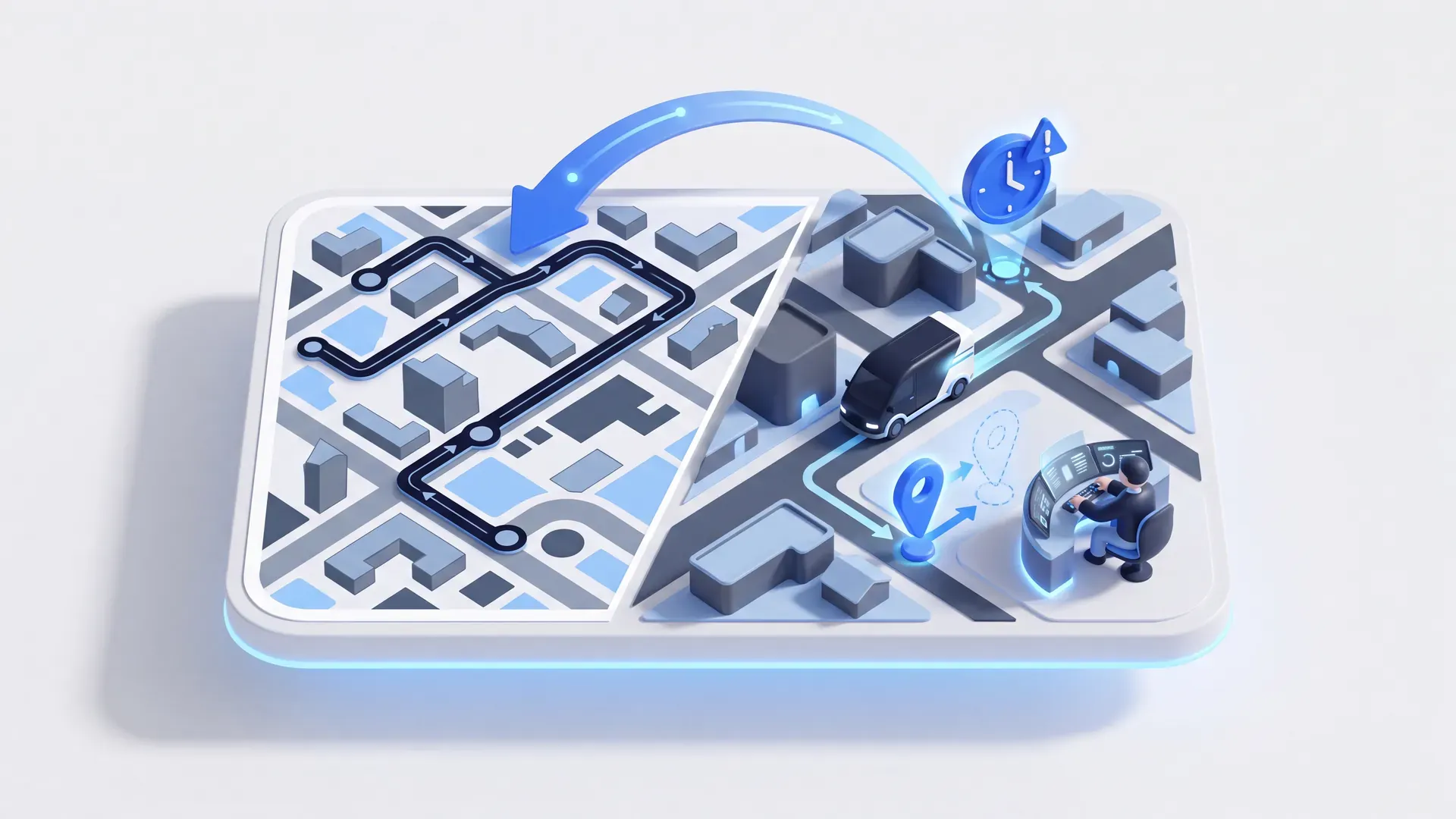
A plan is a prediction. It predicts that a driver will complete a set of jobs within a set time. That the morning cluster will finish by a certain point. That the afternoon run will be done before overtime kicks in.
Those predictions are based on estimates, averages, and assumptions. They're usually close. They're never exactly right.
The question isn't whether the day will diverge from the plan — it will. The question is how you manage that divergence, and whether your operation is set up to respond early or react late.
Why early intervention is almost always cheaper than late intervention
There's a compounding effect to plan deviations. A 20-minute delay on the third job doesn't just affect the third job — it affects every subsequent job on that route, and potentially other routes if resources need to be moved to compensate.
A dispatcher who spots the delay at job three and adjusts the sequence can often absorb the problem with minimal impact. The same dispatcher who doesn't notice until job seven faces a significantly more disruptive problem.
This seems obvious in principle. In practice, early intervention requires two things most operations don't have in combination: timely visibility into what's actually happening, and a clear decision-making process that enables fast, small adjustments without escalation.
What useful visibility actually looks like
'Better visibility' often sounds like a technology recommendation. It doesn't have to be.
The minimum useful visibility is knowing: which jobs are complete, which are in progress, and which are at risk of not being completed as planned. That information can come from a driver app with job status updates, a structured check-in process, or real-time location tracking — depending on your operation and team.
The technology matters less than the habit. Regular, timely status updates that give a planner or dispatcher an accurate current picture of the day are the foundation. Without them, decisions get made on assumptions that diverged from reality hours ago.
What you do with that information matters equally. Visibility without response capability is just information. The goal is to make plan adjustments — resequencing stops, reassign a job, update a customer window — quickly and without rebuilding the entire plan.
Proactive customer communication
One of the most direct service impacts of execution management is customer communication. When something changes — a delay, a rescheduled arrival, an unexpected disruption — the customer experience depends significantly on whether they hear about it from you first, or whether they discover it when the driver doesn't show.
Most customers are considerably more tolerant of delays they're warned about than delays they find out about themselves. Proactive communication doesn't require constant contact — it requires knowing when something has changed and having a clear process for acting on that.
This is another reason early intervention matters: a 20-minute delay flagged at 9am is easy to communicate and easy for the customer to accommodate. The same delay discovered at 3pm, three hours after the expected arrival window, is a service failure.
What execution tells you about your planning
Execution is also where planning inputs get tested against reality. When routes consistently run long, that's a signal that duration estimates are off. When vehicles regularly arrive under-utilized, that may indicate a capacity or constraint issue. When certain areas always cause disruption, that's a signal about how those areas are being planned — not just a bad luck pattern.
This feedback loop — from execution back to planning — is one of the most valuable things an operation can build. Not a formal process necessarily, but a consistent habit: after difficult days, ask what the day revealed about how the plan was built, and what should change.
Plans built from execution-informed inputs require less intervention during the day because they're built on data that reflects what actually happens — not what was assumed to happen when the estimates were first set.
| Building the plan-to-execution loop: |
|---|
| Define what visibility means for your operation — technology or process — and make it consistent |
| Establish who can make adjustments during the day and what kinds of changes need escalation |
| Build a clear process for proactive customer communication when timing changes |
| Review plan vs actual performance regularly — even a brief weekly review surfaces useful patterns |
| Treat recurring execution problems as planning data issues, not just operational noise |
The plan is the starting point. Execution is where it gets tested. And the operations that handle both well — building realistic plans and managing the inevitable gap between plan and reality — are consistently the ones that deliver reliable service while keeping costs in range.