
HOW IT WORKS
How Luminar Works plans and optimizes your routes.
Most platforms show you the results. At Luminar Works, we want you to understand how the plan was built — every constraint applied, every trade-off made — so you can trust what you're dispatching. Built on the same optimization engine behind Sunstone Logistic Systems — made for growing operations.
THE FOUR STEPS
How a route plan gets built.
What you do at each stage — and what happens inside the platform.
Define the business unit settings that govern planning and reporting across your operation: units, currencies, planning rules, and the capacity and availability of each resource. Start with a practical baseline and refine it as you gain experience and your requirements evolve. Every rule you set is applied during optimization.
Upload a CSV or connect through the REST API. Add addresses, service windows, or any operational requirements. The platform works with the structure of your operation, not the other way around. Bring as much or as little detail as you have: everything carries through to planning exactly as entered, and gaps stay empty rather than being filled with guesses.
Every plan involves trade-offs: covering ground faster or spreading load evenly, finishing earlier or using fewer resources. The optimizer uses the Business Type you've selected — time or capacity constrained — and weighs the options and decides the most efficient combinations, sequences, and resource assignments. Treat the result as a starting point you can shape. Adjust a route by hand, change the underlying data, and run it again.
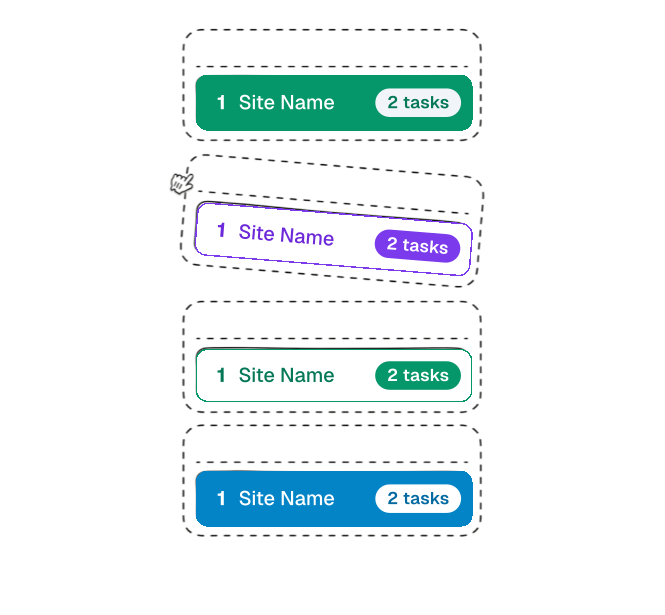
Check route summaries and resource totals, then make the plan yours: drag stops, swap resources, adjust trips. If a change breaks a constraint, it's flagged immediately, so you can edit freely without quietly compromising the plan. When it reads right, publish to confirm it's ready for dispatch.
Perfect routes exist on paper.
Workable plans hold up in the real world.
WHAT BETTER PLANNING DELIVERS
What operations typically gain.
Up to 50%
reduction in route planning time
Time recovered from manual route planning, daily rebalancing, and dispatch adjustments — every week.
+5–15%
resource utilization
Improvement in how fully resources are used when capacity rules are enforced during planning rather than estimated.
10–20%
route distance reduction
Reduction in total distance compared with manually planned routes for the same stop list.
THREE OPERATIONAL CONSIDERATIONS
Routing options to match your operation.
Single-day planning
Build efficient daily routes that account for operational constraints, service commitments, and last-minute changes.
Multi-day planning
Plan beyond today by optimizing routes, workloads, and resource utilization across multiple days.
Capacity planning
Plan within the limits of each resource, ensuring no route is assigned more than it can handle.
WHAT THE OPTIMIZER REFUSES TO DO
Operational integrity, by design.
Some platforms accept impossible plans and pass the problem on, where it surfaces in the field, during dispatch, or on a call with a customer. Luminar Works catches it before the plan leaves the dashboard.
No route is assigned more than the resource can carry or handle. Overloads are caught in planning, not at loading.
Work is scheduled only when the resource is genuinely available, and never in two places at once.
Routes are planned on achievable travel times between stops, not straight-line estimates that fall apart on the road.
If the plan commits to a window, the route can actually make it. Windows are enforced during optimization, rather than checked after the fact.
Questions worth asking before you start.
What's the difference between route planning and route optimization?
Route planning is the broader task, deciding which stops go on which routes, in what order, with which resources. Optimization is the specific step where the platform works out the best sequence for every stop while maximizing vehicle capacity and resource utilization, all within your rules and requirements. Luminar Core covers manual route planning; Smart Planning adds the optimization engine — automated, multi-stop, and constraint-aware. Both are route planning. Optimization is the part the algorithm handles.
How is Luminar Works different from typical route optimization platforms?
Luminar Works is built for growing businesses, not scaled down from enterprise systems. Instead of one rigid bundle, our modular design lets you subscribe to the capabilities you need and add more as you grow. Start for free, see the results on your own routes, and upgrade when it earns its place — no sales calls, no lock-in, no paying for features you don't use. The optimization quality is enterprise-grade; the experience is built around you.
How long does an optimization run take?
Most runs finish within a few seconds. Runtime varies depending on the number of stops, available resources, planning horizon, and constraints being considered. Larger or more complex scenarios take longer as the optimizer evaluates a broader set of options. A progress indicator stays visible while a run is underway.
Can I override the optimizer's decisions?
Yes, everything is editable. Route assignments and stop sequences are yours to control: drag stops into a different order or route, and swap resources as needed. The platform does the heavy lifting; you make the final call.
Can I plan for different vehicle types?
Yes. Assign each resource a vehicle profile — bike, car, or truck — and the platform plans around how that vehicle actually moves: its speed, its capacity, and the roads it can use. Run a mixed fleet and it's planned as one, with each profile routed on its own realistic travel times rather than one generic assumption.
Is my data secure / GDPR compliant?
Yes. Luminar Works is committed to protecting your data, and the platform is built to support GDPR compliance. We’re transparent about how we collect, use, store, and share your information — the full detail is in our Privacy Policy.
Do I need a credit card to start?
No. You can start with Luminar Core, our free plan, which includes a 30-day trial of all modules — no card required. Luminar Core supports up to 5 resources, so you can plan real routes with your real data from day one. When the trial ends, continue on Luminar Core's core features, or subscribe to just the modules you want to keep. And if 5 resources aren't enough, stay on Luminar Core and subscribe to additional resources only — no module subscription needed.
What support is available?
Luminar Works is built to be self-serve, and so is our support. You'll find video walkthroughs, detailed integration docs, and an in-app chat that can answer questions straight from our support documentation. If you're still stuck, raise a support ticket and we'll respond within 24 hours.
Be the first when we open worldwide.
We go live internationally in Q4 2026. Join the waitlist for early access and launch updates.