
The balancing act: cost vs service in your operations.
In every route-based operation there's a tension between doing the job cost-effectively and doing it well. This article covers how to manage that tension deliberately — through priority tiers, route-level thinking, and early intervention during the day.
7 min read
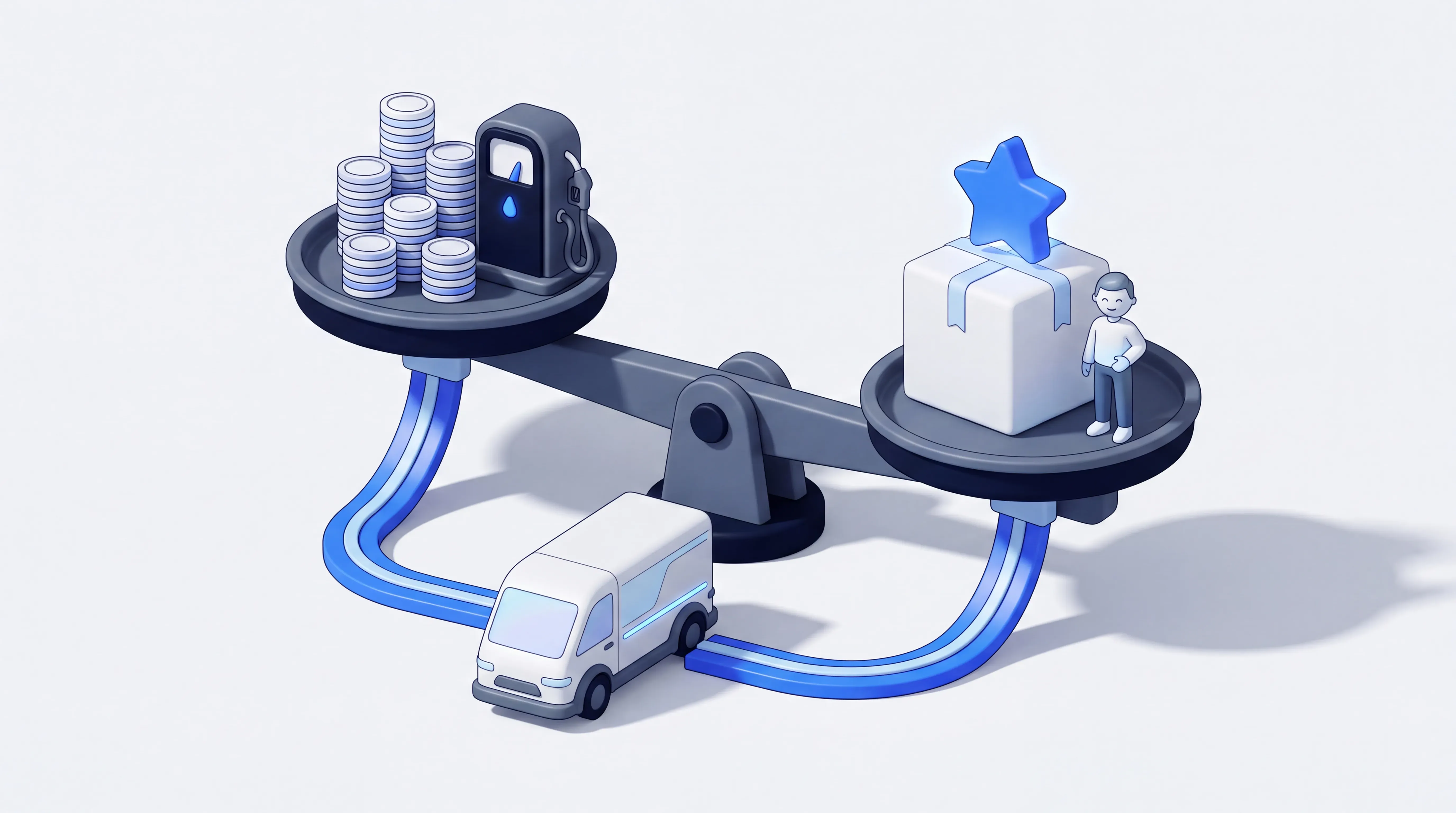
In every route-based operation, there's a tension that never fully goes away: doing the job cost-effectively, and doing it in a way that keeps customers coming back.
These objectives aren't opposed, but they do pull in different directions. Every planning decision — which job goes on which route, how tightly windows are set, how last-minute requests are handled — resolves that tension in some direction. The question is whether you're making those decisions deliberately, or letting them make themselves.
Not all work should be treated the same
One of the most effective ways to manage the cost-service trade-off is to stop treating all jobs as equivalent.
Some deliveries are time-critical — missing the window damages a customer relationship or incurs a penalty. Others have genuine flexibility. Some customers are high-value and highly sensitive to service quality. Others are resilient to minor timing variations.
When all jobs are planned without differentiation, time-critical work doesn't get protected and flexible work doesn't absorb the variance it could. The result is a plan that overcommits on the easy jobs and underdelivers on the important ones.
Defining priority tiers — and making sure the plan reflects them — is one of the clearest levers you have for improving service without adding cost.
Think in routes, not individual jobs
A common trap in routing decisions is evaluating each job in isolation: is this job worth adding to the schedule?
The better question is: what is the total cost of the route this job would go on, and how does adding it change that?
A job that looks worthwhile on its own can add disproportionate cost when it requires a vehicle to backtrack, puts a route in a different geographic zone, or pushes an already-tight schedule past breaking point. Conversely, a job that looks marginal might fit naturally into an existing route at minimal additional cost.
Planning decisions made at the route level consistently produce better outcomes on both cost and service dimensions than decisions made job by job.
Shape demand toward efficiency where you can
The trade-off between cost and service isn't fixed. It's partially determined by the structure of demand — when work comes in, where it's located, and how urgently it needs to be done.
Operations that accept any job anywhere at any time often do so at significant cost. Not just in fuel, but in route quality: isolated jobs create routes that are expensive to run, hard to balance, and that absorb the variance that other jobs in the plan should be absorbing.
Where possible, shaping demand toward efficient patterns — through service day zones, geographic routing tiers, or pricing that reflects the real cost of out-of-area or same-day requests — directly reduces planning cost without reducing service quality for customers in efficient coverage zones.
This doesn't mean refusing work. It means being deliberate about what you charge for work that disrupts efficient planning.
Manage the day with small adjustments, not large reactions
Even a well-built plan encounters reality. Delays happen, priorities shift, customers reschedule.
The cost-service trade-off plays out during the day too. A small early adjustment — resequencing two stops, reassigning one job — usually preserves both cost and service. A large reactive change mid-afternoon — rebuilding a route, dispatching an additional vehicle — usually costs more and delivers less than the original plan would have.
The discipline of managing with small, early interventions rather than large, late ones is one of the most direct ways to protect both dimensions simultaneously. It requires visibility into what's happening during the day — but more importantly, it requires a clear decision-making process so that interventions happen before problems compound.
| Practical levers for managing cost and service together: |
|---|
| Define explicit priority tiers for job types and customers — and reflect them in the plan |
| Evaluate route-level cost when making assignment decisions, not just whether a single job 'fits' |
| Consider pricing or scheduling structures that shape demand toward efficient coverage patterns |
| Build a clear process for making early, small interventions during the day |
| Review where cost and service are actually trading off — it's often in a small number of predictable situations |
The businesses that manage cost and service well aren't usually making dramatic choices between them. They're making many small, deliberate decisions — in how they prioritize, how they plan, and how they manage the day — that collectively keep both in range. That consistency, over time, is what reliable operations are actually built from.